what tshirt to wear to a metal concert in the us
More than merch: why band T-Shirts are so important

By Eamonn Forde, 21 November 2018. Updated 21 Nov 2019.
half dozen Music's T-Shirt Twenty-four hour period takes place on Friday 22 November and, for the 12th year running, celebrates the humble ring T-Shirt. The concept is quite articulate: you wear your favourite tee, so transport us a photo by using the #TShirtDay hashtag and nosotros'll play a song past that deed.
Just more than but a memento from a gig, or a way of showing your musical colours, band T-Shirts can be of considerable importance - to both creative person and fan. So, nosotros've decided to dig a bit deeper to find out simply how important band T-Shirts can be.
Later all, merch is a considerable part of a musician's income. The Licensing Industry Merchandisers' Association reported that the global music merchandise marketplace (of which T-Shirts are a considerable office) was worth $3.1 billion in 2016, up nine.4% from the $2.83 billion generated in 2015. To put that in perspective, the gross revenue from live music concerts worldwide during 2016 was $iv.88 billion; while the global market place for recorded music that same yr was worth $xv.7 billion, according to IFPI. So, nonetheless a vital source of income for artists.

Of all music merchandise, ring T-Shirts go on to be the items that spark fans' interest the almost. Christiaan Munro, manager of merchandise company Sandbag, who work with acts like Radiohead and Arcade Fire, tells u.s.: "The T-Shirt is always the biggest seller - for every creative person."
What makes a great band T-Shirt?
We all have our favourites, but a good ring T-Shirt is heart-catching and instantly memorable, and some designs have become so well known that they've implanted themselves into pop culture. Rolling Stones' 'Natural language and Lip' logo, for example, has become and so iconic by this point that they don't fifty-fifty need to print the ring's name aslope it on their T-Shirts. The design first appeared on the dorsum sleeve of the grouping's 1971 anthology 'Gluey Fingers' and has since get even more well-known than the record's front encompass.
The very best T-Shirts piece of work in lockstep with anthology artwork, such every bit Sonic Youth'due south 'Goo' T-Shirt, direct promoting an artist release. And, as anthology artwork gets shrunk to a thumbnail on a mobile phone screen, T-Shirts are arguably even more important today in doing the heavy lifting visually for an act.

A unique band logo is beneficial as well and, in particular, rock and metal artists do this really well, with acts like AC/DC and Iron Maiden perfecting this early in their careers. These genres have long utilised band T-Shirts equally a way of cultivating an aesthetic for their scene. This is why, says Marking Meharry, the CEO of artist-branded marketplace Music Glue, that "the world of rock tends to sell more trade" than other genres.
In hip hop meanwhile, Run‐D.M.C understood the power of the name as a brand and applied that to their merchandise, every bit did Wu-Tang Clan with their signature "W". These days, rap groups like Odd Future and Brockhampton take continued this legacy and made merchandise nigh as important a function of their identity as their music itself. Tersha Willis, co-founder of Terrible Merch, says that her company has noticed a meaning genre shift in recent years, maxim that hip hop and crud acts are "starting to sell a lot more than T-Shirts now".
How much coin practise artists make from them?
T-Shirts are now such a large office of how acts make money equally revenue from physical sales experiences a refuse. But revenue and profits are non the aforementioned thing, then how much of the money you paid for a T-Shirt really makes it back to the artist you're supporting?
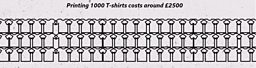
Willis says many of the acts they work with would await to pay around £5 per unit of measurement for printing and product for a T-Shirt based on a run of l-250 garments. A bulk order could see the per-unit cost drop to £2.50 but that would be based on 1,000+ items, something only the largest of acts could comfortably sell out of and non be left with mountains of unsold stock.
However, there are many hidden costs that the consumer does not see. In the Britain, VAT swallows up twenty% of the sale toll. Then at the venue, acts can be charged either a flat fee or a percent of turnover for that nighttime for simply having a trade stand at the venue. "This is the thing that actually needs to be said – the people who earn the almost out of the products, apart from the tax human, are these concession companies," says Sandbag director Munro.
Artists can make around £4.80 from a T-shirt sold for £xx
For hosting and staffing the trade stand, many venues with a capacity of around 10,000 and upwards have anywhere between 20% and 30% of gross – fifty-fifty as much equally 40% in some cases. For acts on the road, Munro estimates that – afterwards the venue cutting and taxes are accounted for – they might take to work with 55% of the retail price. So, for a T-Shirt that cost £5 to make and sold for £20, the margin after deductions would exist £6 - of which the act's managers would typically take 20%, so that's really more in the region of £iv.80.
For venues around the 1,000-capacity level, acts may be charged a fee of £60-80 for a table at the back of the venue regardless of how much merchandise they sell. Grassroots venues though, specifically those with a maximum chapters of 300, commonly charge naught for trade tables. So this tin oft allow smaller, DIY acts to accept home more of your £20.
How does this compare to streams and CD sales?
How does this compare to other forms of income for artists? The number of streams needed to generate the same revenue as a T-Shirt sale varies between different services (Spotify: vi,549 streams, Apple tree Music: two,554 streams, YouTube video: 27,027 plays, according to Digital Music News in 2017), but trying to figure out how much profit of a stream or CD sale makes information technology back to the creative person is oftentimes a "how long is a piece of cord?" argument; and there are and then many factors – royalty rates and manufacturing costs among them.
But based on figures published by Digital Music News, a Spotify play a few years ago, before the streaming service changed how it calculated royalties, could generate $0.007 (£0.0055) per stream. Out of that, however, a mechanical royalty in the UK would be payable to the publisher and songwriters (up to 20%, co-ordinate to the Music Managers Forum) and the remainder is dissever between the tape label and the human action depending on the terms of their contract (so that could be anything from a single-effigy royalty percent for a new act to 20%+ for a major human action who had deftly renegotiated their contract). Of course, an act will but starting time to encounter royalties paid through when they are fully recouped and just a small pct of signed acts detect themselves in this position.
Meanwhile, some acts who handle all their royalties themselves can often take dwelling a lot more from streaming. Car Seat Headrest, for example, revealed last year that he had fabricated almost $xxx,000 from streams of his self-released albums since 2013.
For a CD sale, an act could over again earn annihilation from a single-figure royalty percentage to 20% – but this is afterwards the retailer's cut, VAT, mechanical royalties and manufacturing costs are deducted. If an act, however, controls their own publishing and acts equally their own characterization, recording at home for side by side to nothing and selling £10 CDs at the back of their gigs, afterward manufacturing costs are taken out (which can be every bit little as £320 + VAT for 500 units in a card wallet), they could exist looking at 90% margin afterwards they take covered the cost of the pressing run. It is important to annotation, however, that these are only guide figures and every act volition be operating under very different circumstances.
Who owns the rights? And is bootlegging still a problem?
The rights holders also have to be considered when it comes to T-Shirt designs. In terms of ownership of the artwork that features on ring tees, the deed or label would oftentimes own information technology outright. New acts will oftentimes design their T-Shirts themselves or have an creative friend help out. If they desire something more professional, they can commission a designer who may take a percentage on a licensed footing or, more typically, work on a buy-out fee.
Bootlegging is no longer just people exterior a gig, it has migrated online
Meanwhile, the copyright for an iconic pattern like that of Joy Sectionalisation's famed Unknown Pleasures remains a greyness area due to the fact that it depicts a scientific image (radio waves from pulsar CP 1919), perhaps explaining why there's been so many parodies of the shirt since. (In 2012, Disney started selling a Mickey Mouse-themed reworking of the classic T-Shirt, before quickly taking the item off sale post-obit complaints.)
The bootlegging of T-Shirts has become an increasingly serious concern, too. Information technology is no longer but the people on the pavement after a gig hawking knock-off T-Shirts; instead a lot of the procedure has migrated online, and it is upwards to those owning the copyright to monitor infringements and outcome takedowns.
Munro is a founder and director of TRAP (Trademark & Rightsholders Confronting Piracy) and reveals that the organisation has issued "more than a meg takedowns in the two years that we accept been operational."
How much are fans willing to pay for a T-Shirt?
At a gig these days, a band T-Shirt might cost you between £15 or £20. To put this toll in context, that's 0.43 of an average concert ticket, roughly the same cost as a vinyl tape, the equivalent of 7.7 coffee shop lattes or 0.22 of a smart speaker.

Some fans are willing to fork out a whole lot more, nonetheless. In 2016, David Bowie teamed up with British manner designer Paul Smith for a special pair of T-Shirts marking the release of his Blackstar anthology. The limited-edition tees were from the designer's web-store for £65. Meanwhile, artists like Kanye West and Justin Bieber take been known to sell T-Shirts for up to $200, often sold at i-off boutique pop-up shops that concenter lengthy queues and waiting times.
If people wore the T-shirt back in the day, they want to become it backHoward Cohen, The Beatles Shop
Certain rare pieces, though, have even been known to be sold for thousands - although that coin goes straight to the collector, or a lucky fan who kept hold of the particular, rather than the artists themselves. A T-Shirt originally on sale at Led Zeppelin's famous 1979 Knebworth show sold for $ten,000 in 2011. A limited-edition Run-D.Chiliad.C/Adidas T-Shirt from the 1980s, meanwhile, has been listed on the Defunkd website for a hefty $13,000.
1 of the virtually expensive vintage items to sell in recent years was a Nirvana 1993 tour T-Shirt that sold for just under $vii,000. What was its unique selling point? Well, it was reportedly worn at the time past Kurt Cobain's bodyguard. And while not technically a ring T-Shirt, a custom-made shirt featuring stencilled slogans and worn by The Clash's Joe Strummer recently sold at sale for a huge £22,500. The shirt had been gifted to Clash fanzine editor Marker Jay in 1977 and remained part of the fan's collection since.
But why the high demand and mark-up for these items? Perhaps it's a mix of nostalgia, the rareness of such items and a current tendency for vintage tees. "Nobody really kept them at the fourth dimension, in that location simply wasn't the memorabilia market place that there is now," Howard Cohen, owner of The Beatles Store in London, told The Guardian. "I had a lot of the old Sex Pistols T-Shirts. I had about half-dozen of them and I've seen them go for £500 each."
"If people wore the T-Shirt dorsum in the day, they desire to get it dorsum. Celebrities are getting into the mix, like Justin Bieber wearing Nirvana shirts. And so at that place's just straight-upwardly collectors. They won't even wear it, they'll simply stash it away."
The bout tee and merch bundle nail
Due to a booming market for vintage T-Shirts, it'southward easy to presume fans only want reprints of classic designs, only appetite goes far beyond this. Meharry says: "You might think with a ring similar Fe Maiden it would exist the classic anthology T-Shirts from the 1980s; simply information technology is the new blueprint for the tour that really races out the door."
T-shirts tin propel an deed into the top twoscore charts
Beyoncé's On the Run Tour Ii merch was released before the stint had even begun (in office, so you could buy ahead and wear the items at the concerts). Obviously anything with bout dates printed might seem to have a finite shelf life, merely such items also work as a memento, a sign that you were there and a much improve gift than a simple ticket stub.
Equally well every bit T-Shirts becoming a major part of the alive prepare-up, their sales accept also become entwined with an creative person's musical releases too. The bulk of the charts is now made up of streams, which take a number of weeks to properly accumulate in aggregate and make their presence felt. In order to drive the critical opening-week sales that tin can propel an act into the top xl, record companies increasingly rely on bundling, essentially packaging together an album with something else (invariably a T-Shirt or gig ticket) through D2C (straight-to-consumer) stores.
A limited-edition T-Shirt can take a real bear on on physical album sales, nevertheless the concept is not without controversy. The merch bundle phenomenon made headlines this summer after Nicki Minaj claimed that the technique was responsible for Travis Scott's record 'Astroworld' reaching the US number one spot alee of her album Queen. "Travis sold 200K in his first week of clothes alone," Minaj tweeted in August, calling on the Billboard charts to change their rules regarding how ticket and merch bundles equate to album sales.

How the T-Shirt industry is changing
Changes are beingness in the merchandising manufacture, some of which could initially see profit margins taking a striking, merely will eventually result in a more ethical market.
We've made products using recycled material... we couldn't sell them quick plentyChristiaan Munro, Sandbag
For example, sustainable trade is on the up. In an age of fast fashion and concern well-nigh the bear upon of mass production on both factory workers and the environment, there is a growing need to ensure products are ethically sound. "You can get T-Shirts that are as cheap as chips," says Munro, going on to stress the importance of NGO-led inspections of supplier factories.
Parallel to this is a business concern about over-producing. For major acts, overestimating demand can lead to cotton landfill, but for smaller acts it can hateful racking up unsustainable losses. Engineering science is coming into its ain here, with sales data existence used to anticipate demand for a tour and press-on-demand means acts can order extra shirts while touring and have them delivered to the venue within a matter of days.
Willis says Terrible Merch is about to launch an app for touring acts that removes as much of the pain here equally possible. "It is a full app for bands who go on the road. We will be able to know exactly where they are, what they volition need, what their inventory is on the road, what we accept in stock with the states and what we need to get made for shows that are coming up."
If an deed is left with excess stock, withal, it can withal accept a new life. "We have washed a chunk of products using recycled material," says Munro. "For Jack Johnson we did a surfboard cover, cushion covers and blankets. For Radiohead's crying minotaur [on the embrace of Amnesiac] we turned that into a soft toy using excess T-Shirt stock. We couldn't sell them quick plenty!"

More than than just a T-Shirt...
Finally, non just merely a way for musicians to brand coin, T-Shirts are important in many other ways as well.
I met a girl in a Morrissey T-Shirt... nosotros're at present happily married with a son (whose heart proper name is Morrissey)Richard, 6 Music listener
They can represent and ascertain a band's prototype. "You take an artful around what you do and what you stand up for," says Darren Hemmings, founder and MD of strategic digital marketing consultancy Motive Unknown, who work with Run The Jewels and alt-J, among others. "There has e'er been a visual to define, accompany and raise what they do. Expanding that into the realms of trade is a logical pace."
T-Shirts also work well as a manner of connecting artist and fan. They become visual shorthand and transport out a message that the act whose proper name is emblazoned on their breast is definitely worth checking out. In an age of saturated social media activity, a T-Shirt spotted in the real world can, through keen design, stand out and put musicians in the eyeline of people who might otherwise be unaware of them.
Seeing someone wearing the T-Shirt of a band you lot've never heard of can be a great tool of musical discovery also, as vi Music listener Harry remembers how he saw someone at his school wearing a Shamen T-Shirt, so he decided to give them a listen. "I became obsessed with their early stuff then heavily that the lad gave me the shirt literally off his back," he says.
They tin can bring people together too, as Richard, another vi Music listener, tells us: "Back in 1991 I'd just moved to a new city to start university. I didn't know a soul, only one of the easiest means of working out who was potentially a agreeing soul to hang around with was to expect at their ring T-Shirts and go from there. 1 mean solar day, I met a girl in a Morrissey T-Shirt and information technology turned out she'd been to see him just the nighttime before. We hitting it off instantly. 27 years later, we are happily married with a son (whose eye proper name is Morrissey)."
Follow us on Facebook, on Twitter @BBC6Music, or on Instagram @BBC6Music.
More from 6 Music
Source: https://www.bbc.co.uk/programmes/articles/56nG2R2ps7YJCDyG76Wjbvf/more-than-merch-why-band-t-shirts-are-so-important
0 Response to "what tshirt to wear to a metal concert in the us"
Post a Comment