Jura-13 First Taken Married Woman
| Scottish Gaelic name | Diùra |
|---|---|
| Pronunciation | [ˈtʲuːɾə] (  heed ) heed ) |
| Scots name | Jura[1] |
| One-time Norse name | Dýrøy |
| Meaning of name | Onetime Norse for 'deer island'[ii] |
 Craighouse from the pier with the Paps of Jura in the background | |
| Location | |
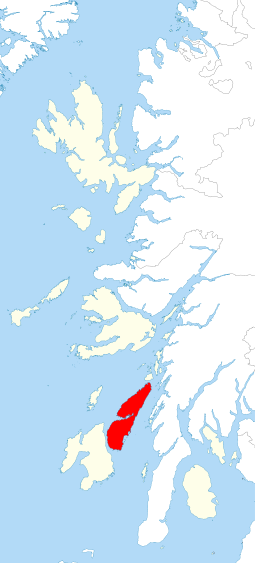 | |
| Jura Jura shown within Argyll and Bute | |
| Os grid reference | NR589803 |
| Coordinates | 56°N 6°W / 56°Due north 6°W / 56; -6 |
| Physical geography | |
| Island group | Islay |
| Surface area | 366.92 km2 (142 sq mi) |
| Expanse rank | eight[3] |
| Highest elevation | Beinn an Òir, 785 thousand (2,575 ft) |
| Administration | |
| Sovereign state | Britain |
| Country | Scotland |
| Quango area | Argyll and Bute |
| Demographics | |
| Population | 196[4] |
| Population rank | 31[three] |
| Population density | 0.5/km2 (ane.3/sq mi)[iv] [2] |
| Largest settlement | Craighouse |
 | |
| References | [2] [5] |
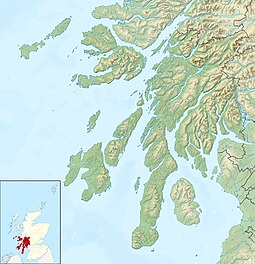

Jura ( JOOR-ə; Scottish Gaelic: Diùra; Scots: Jura) is an island in the Inner Hebrides of Scotland, adjacent to and northeast of Islay. With an area of 36,692 hectares (142 sq mi), and 196 inhabitants recorded in the 2011 census,[4] Jura is more sparsely populated than Islay, and is one of the least densely populated islands of Scotland: in a list of the islands of Scotland ranked by size, Jura comes eighth,[vi] whereas by population it comes 31st. The isle is mountainous, bare and largely infertile, covered by extensive areas of blanket bog.[vii]
The chief settlement is the eastward coast hamlet of Craighouse.[viii] The Jura distillery, producing Isle of Jura single malt whisky, is in the hamlet,[9] as is the island'southward rum distillery which was opened on 2021. Craighouse besides houses the island'due south store, church, primary school, the Jura hotel and bar, a gallery, craft shop, tearoom and the customs run petrol pumps.
Due north of Craighouse are a number of other pocket-size settlements on or near the east declension: Keils, Knockrome, Ardfernal, Lagg, Tarbert, Ardlussa (home of Lussa Gin) and Inverlussa. George Orwell lived on Jura intermittently from 1946 to 1949, and completed his novel Xix Eighty-Iv while living at a remote farmhouse.[10]
Between Jura's northern tip and the island of Scarba lies the Gulf of Corryvreckan, where a whirlpool makes passage dangerous at sure states of the tide. The southern part of the island, from Loch Tarbert southwards, is designated a national breathtaking surface area (NSA),[11] one of 40 such areas in Scotland.[12] The Jura NSA covers xxx,317 hectares (117 sq mi): 21,072 of land and 9,245 of adjacent body of water.[13]
Proper name [edit]

Satellite picture of Jura
The mod name Jura dates from the Norse-Gael era. Two different Old Norse words take been suggested:
- Dyrøy significant 'deer island' is the generally accepted derivation.[2] [14]
- Jurøy , meaning 'udder isle', in reference to the Paps of Jura.[ii]
The proper noun was recorded in 678 equally Doraid Eilinn ,[ii] mayhap pregnant "Doraid's Island".[15]
Settlements [edit]
OS settlements [edit]
Places classified as settlements[16] by the Ordnance Survey include:
- Ardfernal
- Ardmenish
- Craighouse
- Inverlussa
- Keils
- Kinuachdrachd
- Knockrome
- Lagg
- Leargybreck
- Tarbert
Not OS settlements [edit]
These places aren't classified equally settlements by the Ordnance Survey only are shown on the A-Z Great britain Road atlas 2022[17]
- Ardfin
- Ardlussa
- Cabrach
- Feolin Ferry
- Lealt
- Lussagiven
Geology [edit]
Jura is composed largely of Dalradian quartzite, a hard metamorphic rock that provides the jagged surface of the Paps. On the western half of the island the quartzite has been penetrated by a number of linear basalt dykes that were formed during a period of intense volcanic action in the early Palaeogene period, 56 million years ago. The dykes are most apparent on the due west coast, where erosion of the less-resistant rock into which they are intruded has left them exposed as natural walls. The west declension also has a number of raised beaches, which are regarded equally a geological feature of international importance.[18]
Paps of Jura [edit]

The island is dominated by three steep-sided conical quartzite mountains on its western side, the Paps of Jura, which rising to 785 metres (2,575 ft).[19] There are iii major peaks:
- Beinn an Òir (Gaelic: 'mountain of aureate') is the highest, standing at 785 metres (two,575 ft),[nineteen] and is thereby a Corbett.
- Beinn Shiantaidh (Gaelic: 'holy mountain') stands at 757 metres (2,484 ft) loftier.[19]
- Beinn a' Chaolais (Gaelic: 'mount of the kyle') is the lowest of the Paps, reaching 733 metres (two,405 ft).[20] [19]
The Paps dominate the landscape in the region and are visible from the Mull of Kintyre and, on a clear day, from the Isle of Skye and Northern Ireland. The route of the annual Isle of Jura Fell Race includes all iii Paps and iv other hills.
These hills were the subject field of William McTaggart's 1902 painting The Paps of Jura,[21] displayed in the Kelvingrove Art Gallery and Museum.[22]
History [edit]
Early years [edit]

A Neolithic monument at Tarbert
Evidence of settlements on Jura dating from the Mesolithic period was first uncovered past the English archaeologist John Mercer in the 1960s.[23] There is a Neolithic chambered cairn at Poll a' Cheo in the southwest of the island.[24]
Jura is closer to Ireland'due south northern province of Ulster than it is to Glasgow, so it should not be unexpected that Irish people crossed the Straits of Moyle and established the Gaelic kingdom of Dál Riata. Information technology was divided into a scattering of regions, controlled by particular kin groups, of which the Cenél nÓengusa controlled Jura and Islay.[ citation needed ]
The kingdom thrived for a few centuries, and formed a springboard for Christianisation of the mainland. Information technology is believed that Jura may take been Hinba, the island to which the 6th-century missionary, Columba, retreated from the monastic community he founded on Iona, when he wished for a more contemplative life.[25]
Vikings [edit]
Dál Riata was ultimately destroyed when Vikings invaded, and established their own domain, spreading more extensively over the islands northward and w of the mainland, including Jura. This became the Kingdom of the Isles, but following the unification of Kingdom of norway, the islands were under tenuous Norwegian potency, somewhat resisted by local rulers, like Godred Crovan. Following Godred'southward expiry, the local population resisted Norway'south selection of replacement, causing Magnus, the Norwegian rex, to launch a military campaign to affirm his dominance. In 1098, nether pressure from Magnus, the king of Scotland quitclaimed to him all sovereign authority over the isles.[ citation needed ]
To Kingdom of norway, the islands became known as Suðreyjar (Old Norse, traditionally anglicised as Sodor), meaning southern isles. The former territory of Dal Riata acquired the geographic description Argyle (now Argyll): the Gaelic coast.

The remains of Claig Castle, a vital stronghold of Somerled
Half a century later, however, Somerled, the husband of Godred Crovan's granddaughter, led a successful revolt confronting Norway, transforming Suðreyjar into an independent kingdom. Somerled congenital the ocean fortress of Claig Castle on an island at the southern tip of Jura, establishing control of the Sound of Islay; on account of the Corryvreckan whirlpool, this essentially gave him control of the bounding main traffic between the Scottish mainland and the Hebrides.[ commendation needed ]
After his death, nominal Norwegian dominance was re-established, but de facto authority was split between Somerled's sons and the Crovan dynasty. Somerled's son Dougall received the role of Jura due north of Loch Tarbert (along with adjacent islands further north), while Dougal'due south nephew Donald received the remainder of Jura, likewise as Islay, and lands to the east. Information technology is unclear why Jura was carve up similar this, only information technology may take been continued to a dispute with Donald'southward other uncle, Angus, who Donald and his brother had ultimately dispossessed.[ citation needed ]
In the mid 13th century, increased tension between Norway and Scotland led to a series of Battles, culminating in the Boxing of Largs, shortly subsequently which the Norwegian king died. In 1266, his more peaceable successor ceded his nominal authority over Suðreyjar to the Scottish king (Alexander 3) by the Treaty of Perth, in render for a very large sum of money. Alexander by and large acknowledged the semi-independent dominance of Somerled's heirs.[ citation needed ]
Lords of the Isles [edit]
At the cease of the 13th century, king John Balliol was challenged for the throne by Robert de Bruys. By this point, Somerled's descendants had formed into 3 families: the heirs of Dougall (the MacDougalls), those of Donald (the MacDonalds), and those of Donald'southward brother (the MacRory); the MacDougalls took John's side, while the MacDonalds and MacRory backed de Bruys. When de Bruys defeated John, he declared the MacDougall lands forfeit, and gave them to the MacDonalds. John of Islay, the caput of the MacDonald family married the heir of the MacRory family, thereby acquiring the remaining share of Somerled'southward realm, and transforming it into the Lordship of the Isles, which lasted for over a century.[ citation needed ]
Throughout all this time, the descendants of the Cenél nÓengusa had retained their identity; they were now the MacInnes (not to be confused with similarly named groups elsewhere in Scotland). Though the MacDougalls had had authority over part of Jura, the MacInnes had been left in unmolested possession of the land, as vassals. Now, however, with the MacDonalds in accuse of the entire island, the situation changed. The caput of the MacDonalds was unhappy to accept tenants who had supported John Balliol and the MacDougalls, and so, in 1358, he asked the chief of the MacLean family unit to assassinate the MacInnes' leaders; so thorough was this carried out that to this 24-hour interval the MacInnes accept had no-one to become their new primary, and consequently they dispersed throughout Scotland.[ citation needed ]

Glen Garrisdale, the site of Aros Castle
In 1390, the caput of the MacDonald family - the Lord of the Isles - granted the MacLeans the lands of northern Jura (the lands which had belonged to the MacInnes). The MacLeans established a castle in Glen Garrisdale, as a stronghold, which they named Aros Castle, like one of their castles elsewhere.[ citation needed ]
Towards the end of the 15th century, the Lords of the Isles made increasing efforts to constitute full independence. John MacDonald, the so Lord, launched a severe raid on Ross, in pursuance of this aim. Within 2 years of the raid, in 1493, the Lordship of the Isles was declared forfeit, and his realm became function of Scotland, rather than a dependency of the Scottish crown. John was exiled from his quondam lands, and his quondam subjects now considered themselves to have no superior except the king. A charter was soon sent from the Scottish King confirming this situation; the charter declares that Skye and the Outer Hebrides are to be considered independent from the rest of the erstwhile Lordship, leaving only Islay and Jura remaining.[ citation needed ]
Campbells [edit]
Initially, the MacDonalds of Dunnyveg remained landlords of the southern part of Jura. Following John MacDonald's death, his grandson and heir, Black Donald, was being kept a prisoner at Innes Chonnel Castle (a stronghold of the Campbells). In 1501, Donald escaped, triggering an coup in his favour in parts of the erstwhile Lordship of the Isles. When Donald was recaptured, in 1506, the king took the precaution of transferring the property of the MacDonald family to the Campbells; in Jura, the Campbells of Craignish were the beneficiaries.[26]
The Campbells established a base for themselves at Ardfin, at the south of Jura, to supersede the nearby MacDonald stronghold of Claig Castle. After a century of intermittent violence between the families, in 1607 the Campbells purchased from the MacDonalds a quitclaim of any rights the latter might accept on Jura.[ citation needed ]
Following the Scottish reformation, the MacLeans (opponents) and Campbells (supporters) came into dispute; to a sure extent, the Campbells as well saw it as an opportunity for territorial expansion. Having complained for several years about harassment from the MacLeans, in 1647 the Campbells launched a surprise attack on Aros Castle, and killed many MacLeans; for many years in the 20th century, a human skull stood on a ledge in a nearby cave, and it was traditionally said to have been the remains of a Maclean who had been killed in this battle.[27] The skull is no longer there, but the latest editions of Ordnance Survey maps yet mark the location as 'Maclean'south Skull Cave'.[19]
The northward of the island, however, remained in MacLean hands until 1737, when information technology was sold to Donald MacNeil of Colonsay. The remainder of the island was ruled and largely owned by the Campbells for a total of three centuries, by xi successive Campbell lairds. Nether Campbell influence, shrieval authority was established nether the sheriff of Argyll. With inherited Campbell control of the sheriffdom, comital say-so was superfluous, and the provincial identity (medieval Latin:provincia) of Islay-Jura faded away. In the mid 18th century, The Heritable Jurisdictions Act abolished both, leaving only the shrieval unit of measurement, and without Campbell control.[ commendation needed ]
Co-ordinate to a local legend, in the early 1700s, the Campbells of Jura evicted a man who prophesied that the terminal Campbell to leave the isle would exist one-eyed with his property carried in a cart fatigued by a lone white horse. In 1938 Charles Campbell, blind in one eye from a war injury, cruel on hard times and led his white equus caballus to the quondam pier for the last time.[28]
Emigration [edit]
Offset in the subsequently 18th century, long before the notorious Highland Clearances of the following century, there were several waves of emigration from Jura. In 1767, fifty people left for Canada, and from so the population fluctuated, rising to a peak of 1,312 in 1831, before gradually shrinking to its 20th century level of merely a few hundred. Mercer notes[29] that although relatively few forced clearances on Jura were recorded, the emigrations were due to factors such every bit hunger and spiralling rents.
Recent history [edit]
Census records show that Jura'south population peaked at i,312 in 1831,[two] and that, in common with many areas of western Scotland, the island'south population declined steadily over the ensuing decades. However, in that location has been a small-scale increase since 2001.[thirty] During the decade from 2001 to 2011 Scottish island populations as a whole grew by 4% to 103,702.[31] Alongside the long-term decline in Jura's population has been a reject in the number of Gaelic speakers. The 1881 census reported that 86.6% of 946 inhabitants spoke Gaelic. In 1961, for the outset time less than half (46.9%) spoke the language and by 2001, this figure had dropped to x.6%.[ citation needed ]
In 1838, the quondam Campbell mansion at Ardfin was remodelled and extended by the architect William Burn for the laird Colin Campbell and renamed Jura Business firm.[32]
During the first half of the 20th century, the Campbells gradually sold the island equally a number of separate estates, showtime with the disposal in 1920 of the northern 2-thirds of the island, from the Paps of Jura and the Corran River all the way to the Corryvreckan. The purchaser was the American-born English language politico Waldorf Astor, whose wife, Nancy Astor had recently become the commencement female MP to sit in the Firm of Eatables.[33] The most southerly part of that conquering, the Tarbert Manor, remains in the hands of the Astor family to this solar day,[34] and in contempo years the latest generation of Astors have restored the remote Glenbatrick Order, which stands on Jura's uninhabited west coast, on the shore of Loch Tarbert.[35] The connectedness between the Campbell family of landowners and lairds and Jura ended in 1938 with the sale of Jura House and its surrounding country, Ardfin Manor.[2]
George Orwell on Jura [edit]
In his afterward life, George Orwell moved to Barnhill, on Jura, living there intermittently from 1946. During that time he was critically ill with tuberculosis. Orwell left Jura in January 1949 to get treatment at a sanatorium in Gloucestershire and never returned to the isle.[36]

He was known to the residents of Jura by his existent name, Eric Blair. He completed 19 Eighty-Four at Barnhill during 1947–48;[37] he sent the final typescript to his publishers, Secker and Warburg, on four December 1948, and they published the book on 8 June 1949.[38] Despite its isolation, Barnhill has in contempo years become something of a shrine for his readers.[39]
During his fourth dimension on Jura, Orwell and his adopted son, a niece and a nephew, nearly lost their lives at the Corryvreckan. He was attempting to navigate the Gulf when the outboard motor fell off the boat. The nephew rowed them to Eilean Mòr, where the boat overturned equally they were disembarking; the group was rescued by the crew of a lobster boat.[40]
Even so endemic by the Fletcher family who had rented it to Orwell, the four bedroom Barnhill business firm is available for rent just is somewhat archaic for this era. A generator supplies electricity, the modest refrigerator is gas-powered and heat is provided by a coal-fired Rayburn.[41] The original look and feel of the business firm has been retained. "If you stay here, y'all're actually treading in Orwell's footsteps. He would recognise the place instantly if he were to pace through the door today," Orwell Society member Damaris Fletcher told The Guardian.[42]
Authorities and politics [edit]
In 1899, counties were formally created, on shrieval boundaries, by a Scottish Local Government Human activity, under which Jura became part of the County of Argyll. In 1975 the counties were replaced by a two-tier arrangement of regions and districts: Jura formed part of the Argyll and Bute district within the wider Strathclyde region, notwithstanding the Canton of Argyll continues in apply as a registration county. A further re-organization took place in 1995, and Jura now forms function of the unitary quango surface area of Argyll and Bute. The island also has a community council,[43] which is responsible primarily for representing the views of the local community in dealings with other public bodies, although it tin also undertake other activities such every bit fundraising for local projects and the running of community events.[44]
In the Scottish Parliament Jura forms role of the constituency of Argyll and Bute, which elects 1 Member of the Scottish Parliament (MSP) by the first by the mail method of election. It is too one of eight constituencies in the Highlands and Islands electoral region, which elects seven boosted members, in addition to the viii constituency MSPs, to produce a form of proportional representation for the region as a whole.
The electric current MSP for Argyll and Bute is Jenni Minto of the Scottish National Political party (SNP)who was elected in 2021, taking over from her party colleague Michael Russell.
At Westminster Jura is represented as part of a constituency also chosen Argyll and Bute, which is held past Brendan O'Hara, also of the SNP.
Modern ownership [edit]
There are at present 7 estates on Jura and a whisky distillery, all in divide buying.[45]
- Ardfin: situated at the southern tip of the isle, betwixt Feolin and Craighouse. For some 70 years from 1938, Ardfin belonged to the Riley-Smith family, brewers from Tadcaster in Yorkshire. In 2010 the estate was bought by Greg Coffey, an Australian hedge fund manager,[46] and since 2011 its ownership has been with Ardfin Lodge Ltd of Jersey.[47] The famous walled garden of Jura Business firm, which had previously been a noted horticultural asset and popular tourist attraction, has since been closed to the public. Having also wound up the estate'south farm, Coffey then submitted proposals for the construction of a individual 18-hole golf course on the estate. The original Jura Business firm was extended and modernised, and the erstwhile farm buildings were converted into a luxury hotel for the utilize of visiting golfers.[48] The course was completed in 2018 and opened in 2019.[49] The hotel was due to open up at Easter 2020[l] just the opening has been delayed.

Jura House on the Ardfin Estate in the 19th Century
- Inver: lying N of Ardfin, on the west flanks of the Paps of Jura, and belonging to Sir William Lithgow,[51] Vice-Chairman of the Glasgow shipbuilding group Lithgows.
- Jura Forest: also lying northward of Ardfin, but on the east flanks of the Paps of Jura. Forest Estate belongs to the Vestey family,, which was headed until 2021 past Samuel, tertiary Businesswoman Vestey, chairman of the food and farming concern Vestey Group Ltd, and a former Master of the Horse of the Royal Household. The owner is now his eldest son William Vestey, fourth Businesswoman Vestey.[52]
- Tarbert: North of the Corran River, and stretching every bit far equally Loch Tarbert, the Tarbert Manor has been in the hands of the Astor family for over 100 years (meet 'Recent History'). The present Lord Astor is William Astor, 4th Viscount Astor, merely the possessor of the estate is listed equally Chantry Properties Ltd of the British Virgin Islands,[53] whose beneficial owners are Viscount Astor's three children, Flora, Volition and James. Former Prime Minister David Cameron has visited the estate on several occasions, every bit Lord Astor is the stepfather of his wife Samantha Cameron.
- Ruantallain: immediately northward of Loch Tarbert. Ruantallain had been a part of the Tarbert Estate, until its sale in 1984. It is owned past businessman Lindsay Bury,[54] who is a sometime president of the influential wildlife charity Flora and Fauna International.

- Ardlussa: north of Ruantallain. In 1926 the Ardlussa and Barnhill Estates were caused from the Astors by Walter Hargreaves-Brown. The present possessor of Ardlussa[55] is Andrew Fletcher, slap-up-grandson of Hargreaves-Brown.[56] Fletcher lives at Ardlussa Firm with his family – they are the only estate owners to be permanently resident on Jura.
- Barnhill: at the northernmost tip of Jura, overlooking the famous Corryvreckan Whirlpool,[57] George Orwell completed his novel Nineteen Eighty-Four while living here. Barnhill is also owned past a member of the Fletcher family.[58]
Jura distillery was founded in 1810 but was not used afterwards 1900 and was dismantled. In 1963, ii estate owners, Robin Fletcher of Ardlussa and Tony Riley-Smith of Ardfin, took over the old property and built a mod distillery; they expanded it in 1978. In 1985, Invergordon Distillers bought Mackinlays; later the 2 companies became office of Whyte & Mackay.[59]
In that location is also a relatively minor area owned by Forestry and Land Scotland.
Economic system [edit]
In an economic survey published in 2005 past the now-defunct Feolin Study Center on Jura,[60] the gross turnover of the island was estimated to be just over £3.2 1000000. This effigy covered production and services only, and took no account of public expenditure by authorities or local authority. In financial terms, the Jura distillery was the largest, and it was also the biggest individual employer, but the island's seven estates, taken together, employed the most full- and function-fourth dimension staff. The distillery is owned by Whyte and Mackay, which in 2014 was taken over by Emperador Distillers, part of the Alliance Global Group Inc of the Philippines. The estates provide deer stalking and other field sports, together with forestry and a diminishing amount of agriculture.
In 2015 a new distillery was established in Ardlussa at the north of the isle, producing Lussa Gin,[61] and in 2021 the island's first rum distillery opened in Craighouse producing Deer Island Rum.[62] Both are small batch, locally owned distilleries.
Tourism is the merely other significant area of economical activity, and in 2005 over twenty% of the isle population was directly or indirectly employed in the tourist manufacture. The distillery, field sports and Jura House Gardens were listed as the main tourist attractions, although the gardens have since been airtight to the public. More recently, Conde Nast Traveller suggested that visitors would capeesh the many red deer, "and the distinctive Paps of Jura rising above miles of coating bog and freshwater lochans" as well every bit the "remote bays and bothies" or the boat trips to the Corryvreckan whirlpool.[63] The Crude Guides book adds that there is a hotel and some bed and breakfast accommodation on the island, which is "an ideal identify to go for peace and quiet and some dandy walking".[64]
In 2013 Jura Evolution Trust secured financial support from the Big Lottery Fund and other sources to buy the island's only shop, which re-opened equally a community-owned business organization in 2014.[65] The trust is also exploring renewable energy options.
In 2018 a new business organisation hub opened in Craighouse consisting of iv units side by side to the community petrol pumps. These currently firm three local businesses - a photography gallery, Deer Isle rum distillery, and a craft shop - also as the local motorcoach garage.
Since 2019 the Highlands and Islands Send Partnership (HITRANS) have had an office in Craighouse which houses the Scottish Islands Passport project.
Transport [edit]

During the summer the isle has a direct passenger ferry link between Craighouse on Jura and Tayvalllich on the Scottish mainland.[66] This service is run by the community.
Throughout the yr the MV Eilean Dhiura runs a regular service between Feolin on Jura and Port Askaig on Islay, with frequent sailings from 7.30am to half-dozen.30pm Mon-Sat and a reduced Sunday schedule. This service is run by Argyll and Bute Council.
From Islay there are ferry connections to Kennacraig, Colonsay and Oban (all operated by Caledonian MacBrayne) and a seasonal connexion to Ballycastle in Northern Ireland (from Port Ellen). Flights from Islay airdrome also offer connections to Glasgow Airport via Loganair and to Oban and Colonsay via Hebridean Air Services.[67]
Jura has simply one route of whatever significance, the single-track A846, which follows the southern and eastern coastline of the island from Feolin Ferry to Craighouse, a altitude of around 8 miles (13 km). The route then continues to Lagg, Tarbert, Ardlussa and across. A private track runs from the route end to the far north of the island (no vehicle access to the general public).[nineteen] A local bus service on the island is operated by Garelochhead Coaches.[68]
V electric vehicle charging points are available on Jura. One at the whisky distillery, ii in the Village Hall Carpark and two at the commercial units towards the pier, adjacent to the petrol / diesel fuel pumps.
Wildlife and conservation [edit]

| Jura National Breathtaking Expanse | |
|---|---|
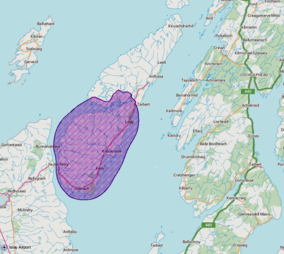 A map of the Jura National Breathtaking Area | |
| Location | Argyll and Bute, Scotland |
| Surface area | 303 km2 (117 sq mi)[13] |
| Established | 1981 |
| Governing body | NatureScot |
The island has a large population of red deer.[69] Through browsing, the deer foreclose the vegetation on the island from turning back to woodland, which is the natural climax community; indeed an alternative caption of the island'due south proper name is that it derives from 'the keen quantity of yew copse which grew in the island'[70] in earlier times.
Jura is also noted for its bird life, and especially for its raptors, including buzzards, golden eagles, white-tailed eagles and hen harriers.[69] Since 2010 Jura has been designated by NatureScot as a Special Protection Surface area for gilt eagles.[71] Similar many other parts of the Hebrides and western Scotland, the shores of Jura are frequented by grey seals, and the elusive otter is also relatively common here, every bit is the adder, the U.k.'s merely venomous snake.[69] The seas around Jura course function of the Inner Hebrides and the Minches Special Area of Conservation due to their importance for Harbour porpoises.[72]
Literary accounts [edit]
In 1549, Donald Monro, Dean of the Isles, wrote that the island was "i ather fyne forrest for deire, inhabit and manurit at the coist syde", with "fresche h2o Loches, with meikell of turn a profit" and an abundance of salmon.[73] [Note ane]
Withal, when the soldier and military historian Sir James Turner visited Jura in 1632, he was less impressed, reporting that '[it is] a horride ile and a habitation fit for deere and wild beastes'.[74]
Only at the end of the 17th century, the writer and traveller Martin Martin went at that place and ended that 'this isle is perchance the wholesomest plot of footing either in the isles or continent of Scotland, as appears past the long life of the natives and their state of health'. Martin noted some extraordinary examples of longevity, including one Gillouir MacCrain, who was declared to take kept one hundred and lxxx Christmases in his own business firm. And he was impressed by the practiced wellness of the inhabitants: 'There is no epidemical affliction that prevails here. Fevers are only seldom observed past the natives, and whatsoever kind of flux is rare. The gout and agues are not then much as known by them, neither are they liable to sciatica. Convulsions, vapours, palsies, surfeits, lethargies, megrims, consumptions, rickets, pains of the stomach or coughs, are not frequent here, and none of them are at whatsoever time observed to become mad.'[75]
Culture [edit]

Like all inhabited Hebridean islands, Jura has its own indigenous tradition of Gaelic song and poetry.[76] [77] Since 1993 it has too been the home of the Jura Music Festival,[78] which takes identify annually in September.
Jura is featured in the plot of the 2003 novel A Question of Claret by Ian Rankin, and the 2007 novel The Careful Use of Compliments past the Scottish writer Alexander McCall Smith, and is a setting for some of the narrative and activity in Anne Michaels' 2008 novel The Winter Vault. The island is the setting for the novel "Burning down George Orwell's house, "by Andrew Ervin. In music, Jura is mentioned in: "Crossing to Jura", a song by R. Kennedy and D. MacDonald, recorded in 1997 by JCB with Jerry Holland on the album A Trip to Cape Breton; "The Bens of Jura", a song past Capercaillie; and "Isle of Jura", a song by Skyclad. The UK ring Mekons recorded an album on the island in 2015 and called it 'Jura'.
The 2010 anthology Poets and Lighthouses past Tuvan singer Albert Kuvezin of the band Yat Kha was recorded and produced by the British musician Giles Perring on Jura, with some of the performances existence recorded in the (now largely felled) wood at Lagg. The anthology, which featured a photo of the Skervuile Lighthouse in the Sound of Jura as its cover, reached Number one in the European World Music Charts in January 2011.
Jura and The KLF [edit]
Jura is also known for an event of 23 August 1994, when Bill Drummond and Jimmy Cauty, formerly known as the music group The KLF, filmed themselves called-for £i million in banknotes in the Ardfin boathouse on the south coast of the island.[79]

The beach below Jura House, Island of Islay in the distance.
Notes [edit]
- ^ Translation from Scots: "some other fine deer forest, manured and inhabited at the coast" and "freshwater lakes, with much turn a profit".
Footnotes [edit]
- ^ "Map of Scotland in Scots - Guide and gazetteer" (PDF).
- ^ a b c d e f g h Haswell-Smith (2004) p. 47
- ^ a b Area and population ranks: in that location are c. 300 islands over 20 ha in extent and 93 permanently inhabited islands were listed in the 2011 census.
- ^ a b c National Records of Scotland (15 August 2013). "Appendix 2: Population and households on Scotland's Inhabited Islands" (PDF). Statistical Bulletin: 2011 Census: Beginning Results on Population and Household Estimates for Scotland Release 1C (Part Two) (PDF) (Report). SG/2013/126. Retrieved 14 August 2020.
- ^ Anderson, Joseph (Ed.) (1893) Orkneyinga Saga. Translated by Jón A. Hjaltalin & Gilbert Goudie. Edinburgh. James Sparse and Mercat Printing (1990 reprint). ISBN 0-901824-25-nine
- ^ Haswell-Smith (2004) p. 502
- ^ Haswell-Smith (2004) pp. 49–fifty
- ^ "Isle of Jura". The Cyberspace Guide to Scotland. Retrieved 7 December 2018.
- ^ isleofjura.com Retrieved 2010-07-xviii.
- ^ The All-time Things To Run into And Do In Jura, The Scottish Island Where Orwell Wrote '1984'
- ^ "Jura National Breathtaking Area". NatureScot. Retrieved 29 September 2020.
- ^ "National Scenic Areas". NatureScot. Retrieved 29 September 2020.
- ^ a b "National Scenic Areas – Maps". SNH. 20 December 2010. Archived from the original on 12 June 2018. Retrieved 24 Jan 2018.
- ^ Mac an Tàilleir, Iain (2003) Ainmean-àite/Placenames. (pdf) Pàrlamaid na h-Alba. Retrieved 26 August 2012.
- ^ "Jura". Undiscovered Scotland. Retrieved 20 March 2018.
- ^ "Search". Geograph Britain and Republic of ireland. Retrieved 3 September 2021. put the 1st part of the name into the "about" box
- ^ "Great United kingdom of great britain and northern ireland A-Z Road Atlas 2022". Collins. Retrieved 3 September 2021.
- ^ "Due west coast of Jura". scottishgeology.com.
- ^ a b c d due east f Ordnance Survey Landranger i:50000, Sheet 61 (Jura and Colonsay).
- ^ Haswell-Smith (2004) p. 50
- ^ "William McTaggart". Machrihanish Online. Archived from the original on 21 Oct 2007. Retrieved 4 April 2007.
- ^ "Kelvingrove Fine art Gallery". planetware.com. Retrieved 4 April 2007.
- ^ Mercer, John (1974). Hebridean Islands. Glasgow: Blackie. ISBN978-0-216-89726-7.
- ^ "Jura, Cladh Chlainn Iain". Historic Environment Scotland. 2018. Retrieved 22 March 2018.
- ^ "The Road North". undiscoveredscotland.co.uk.
- ^ "Island of Jura - Island of Deer". Southern Hebrides of Scotland. 20 Feb 2015.
- ^ "Jura, Maclean's Skull". scotlandsplaces.gov.great britain.
- ^ harmonyrowbc, Author (24 October 2017). "Captain Campbell of Jura (1880-1971)". Glasgow's Benefactors . Retrieved 16 Oct 2019.
- ^ Mercer, J: Hebridean Islands (1974) ISBN 0 216 89726 2
- ^ General Annals Office for Scotland (28 Nov 2003) Scotland'south Demography 2001 – Occasional Paper No 10: Statistics for Inhabited Islands. Retrieved 26 February 2012.
- ^ "Scotland's 2011 census: Island living on the rising". BBC News. Retrieved 18 August 2013.
- ^ "Dictionary of Scottish Architects - DSA Building/Design Written report (October sixteen, 2019, 10:28 am)". www.scottisharchitects.org.united kingdom . Retrieved sixteen October 2019.
- ^ "Explore the Parliamentary collections for documents and artwork about Nancy Astor, the first adult female MP to take her seat".
- ^ "The Astors in Scotland: 100 Years on Jura by Emily Astor". 7 August 2020.
- ^ "Annabel Astor's bothy on Jura is a comfortable oasis in the untamed landscape". 30 December 2020.
- ^ "The Scottish island where George Orwell created 1984". BBC News. 28 April 2018.
- ^ Bowker, Gordon (2004). George Orwell. London: Abacus. ISBN978-0-316-86115-one.
- ^ Bowker (2004) p. 383, 399.
- ^ Paul McHugh (xv March 2009). "Finding Orwell's Source of Hope in Jura, Scotland". The Washington Post.
- ^ VISITING ISLAY? WHY You lot CAN'T MISS OUT ON JURA! 8 November 2016
- ^ "Did yous know you can rent the nigh untouched firm where George Orwell wrote 1984?". Business firm and Garden. xv August 2018.
Virtually untouched since Orwell's day, the house is still owned past the Fletcher family, who rented it to Orwell in the 1940s
- ^ "A bout of Orwell's Jura, where he wrote 1984". The Guardian. 8 June 2019.
The firm where George Orwell penned his masterpiece, published seventy years agone today, has hardly inverse, nor has the brooding and remote Scottish isle he loved
- ^ "Customs Councillors". Argyll and Bute Council. Retrieved 26 March 2018.
- ^ "Customs Councils". Argyll and Bute Council. 14 November 2012. Retrieved 26 March 2018.
- ^ "Who Owns Scotland". whoownsscotland.org.uk.
- ^ "Nocookies". The Australian. 15 April 2011. Archived from the original on 18 Oct 2012.
- ^ "Property Page: Ardfin Estate".
- ^ "Scotland'southward nearly heady hotel opening in 2020: Ardfin". 3 February 2020.
- ^ "Spring unveiling planned for world-class golf game course on Jura". The Scotsman. Retrieved iii January 2020.
- ^ Rex, Steve (3 Feb 2020). "Scotland's near exciting hotel opening in 2020: Ardfin". CN Traveller . Retrieved 29 January 2021.
{{cite web}}: CS1 maint: url-status (link) - ^ "Property Page: Inver Manor". Who Owns Scotland. thirty Dec 2002. Retrieved 22 March 2018.
- ^ "Property Folio: Forest Estate". Who Owns Scotland. 30 September 2002. Retrieved 22 March 2018.
- ^ "Holding Page: Tarbert Manor".
- ^ "Property Folio: Ruantallen Estate". Who Owns Scotland. 21 October 2002. Retrieved 22 March 2018.
- ^ "Ardlussa Estate Isle of Jura - Isle of Jura Accommodation - Ardlussa Business firm". ardlussaestate.com.
- ^ "Property Page: Ardlussa".
- ^ "Escape to jura". escapetojura.com.
- ^ "Did you know you can hire the virtually untouched house where George Orwell wrote 1984?". House and Garden. fifteen Baronial 2018.
About untouched since Orwell's day, the house is still owned past the Fletcher family, who rented it to Orwell in the 1940s
- ^ "JURA HISTORY". Scotch Whisky.
- ^ 'The Jura Economical Survey' (Feolin Study Heart, 2005)
- ^ Page, Front. "LUSSA GIN - From the wilderness of the Isle of Jura".
- ^ https://www.deerislamd.co.uk
- ^ THE 20 About BEAUTIFUL ISLANDS TO VISIT IN SCOTLAND
- ^ Argyll Travel Guide 29 Baronial 2020
- ^ "juracommunityshop".
- ^ http://www.jurapassengerferry.com
- ^ https://www.hebrideanair.co.uk
- ^ "Home - Garelochhead Coaches". garelochheadcoaches.co.uk.
- ^ a b c "Isle of Jura Wildlife". Jura Info. fifteen February 2015. Retrieved 22 March 2018.
- ^ Statistical account of Scotland - Account of 1791-99 vol.12 p. 318
- ^ "Jura, Scarba and the Garvellachs SPA". NatureScot. Retrieved 29 September 2020.
- ^ "Inner Hebrides and the Minches SAC". NatureScot. Retrieved 29 September 2020.
- ^ Monro (1549) "Duray" No. 15
- ^ Porteous, John D. (1968). "The island‐parish of Jura". Scottish Geographical Magazine. 84: 56–65. doi:10.1080/00369226808736072.
- ^ Martin, Martin. "A clarification of the Western Islands of Scotland (1697)". appins.org. Archived from the original on 13 March 2007.
- ^ Simon Ager. "Toirt one thousand' aghaidh ri Diùra". Omniglot. Retrieved 9 November 2008.
- ^ "Da Thaobh Loch Seile". all celtic music. Retrieved ix November 2008.
- ^ "Jura Music Festival".
- ^ Reid, Jim (25 September 1994). "Money to fire". The Observer. Archived (via the Library of Mu) on 16 September 2016.Wikipedia:WikiProject The KLF/LibraryOfMu/387
References [edit]
- Haswell-Smith, Hamish (2004). The Scottish Islands. Edinburgh: Canongate. ISBN978-1-84195-454-vii.
- Monro, Sir Donald (1549) Clarification of the Western Isles of Scotland. William Auld. Edinburgh - 1774 edition.
Farther reading see [edit]
- Youngson, Peter (2001) Jura: Isle of Deer. Birlinn Ltd. Edinburgh. ISBN 1 84158 136 4.
External links [edit]
 | Wikimedia Commons has media related to Jura. |
 | Wikivoyage has a travel guide for Jura . |
- Digitised historic map TIura Insula, The Yle of Iura one of the westerne Iles of Scotland from the Blaeu Atlas of Scotland by Dutch cartographer Joan Blaeu published in 1654
- Jura on Scotlandview Island of Jura Pictures and Comprehensive info
- Orwell's life on Jura
Coordinates: 56°v′N 5°45′West / 56.083°Northward 5.750°W / 56.083; -5.750
Source: https://en.wikipedia.org/wiki/Jura,_Scotland
0 Response to "Jura-13 First Taken Married Woman"
Post a Comment